
May 4, 2026
The 4 Trends that Dominated Conversations at NHPC’s 40th Anniversary
Policy is pulling contractors into advocacy. Technology is pushing them toward smarter systems. Capital is reshaping the competitive landscape. Evolving business models serve more of a home’s total needs.
By: Macie Melendez
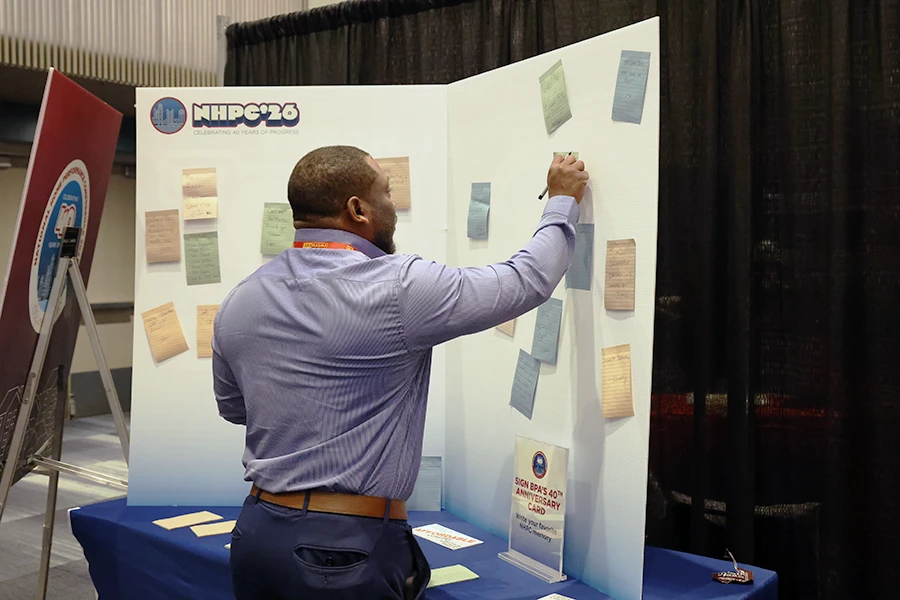
In mid-April, the Building Performance Association (BPA)’s National Home Performance Conference (NHPC) marked its 40th anniversary with a fitting theme: 40 years of progress. It’s a forward-looking tagline, but it inevitably makes you take a backward glance. Four decades ago, building performance was even more niche than it is today. Every aspect of the job was done in person, computers and data were limited, and the idea of a home as a system was just taking shape.
Today, the industry looks very different. And if the conversations from contractors, business owners, and leaders at our annual event are any indication, it’s about to change even faster in the next 40 years.
These four areas of focus are shaping what comes next in our industry: policy, technology, private equity interest, and business diversification.
Policy: From Reactive to Proactive
For many contractors, policy engagement used to be optional. They viewed it as something that happened in the background while they focused on running crews, serving customers, and keeping the lights on. That’s no longer the case.
Many contractors have described the same pattern to us: They only got involved in policy after something went wrong—funding cuts, program changes, or regulatory shifts—that directly impacted their business. In other words, they reacted to policies that had already happened.
Now, there’s a growing recognition that being reactive isn’t viable.
During a contractor breakfast at NHPC’26 in Columbus, Ohio, a contractor said, “Half the time you don’t know there’s a challenge. We have businesses to run and families to enjoy, and then all of a sudden you learn what [programs are] gutted. I am not interested until I’m informed. You simply have to get involved to protect your business interest.”

Contractors are realizing that policy decisions shape many pieces of their business. Federal funding determines whether companies can find and train workers. Tax credits influence customer demand.
Just as important is representation. The people actually doing the work in homes, attics, and crawlspaces often aren’t at the table when policies are designed. That empty chair is becoming harder to ignore.
Additionally, there’s a growing awareness that no program is guaranteed. Even in states with strong climate policies, funding can change quickly. The lesson many are learning is that if they’re not paying attention, they may not realize what’s at risk until it’s already gone.
Technology: AI is Here to Stay
If policy is creating external pressure, technology—particularly AI—is reshaping internal operations.
There’s no shortage of excitement around AI-powered tools promising to streamline everything from customer communication to job pricing and scheduling. But the most grounded voices in the room offered a more measured take. As NHPC’26 general session speaker Tersh Blissett said, “AI doesn’t solve broken systems. It amplifies them.”
In other words, layering automation on top of disorganization just creates faster disorganization.

The contractors seeing real value from AI are starting smaller and thinking more strategically. The focus isn’t on flashy, all-in-one solutions, but on identifying repetitive tasks (things you do multiple times per week) and automating those first. Customer appointment confirmations, follow-ups, online review responses, and proposal generation are the kinds of workflows where AI can immediately save time.
There’s also a shift in how people think about implementation. Instead of jumping straight to automation, Blissett says to follow a three-step sequence: optimize, automate, delegate. Fix the process first, then let technology handle the repeatable parts, and, therefore, free up human capacity for higher-value work.
Perhaps most importantly, there’s a recognition that AI still requires human judgment. It’s a tool, not a replacement. The companies that treat it as a partner (not a shortcut) are the ones who will benefit most.
Business: Private Equity and HVAC
While policy and technology are reshaping how companies operate, private equity is reshaping who owns them. In particular, our industry is seeing this with HVAC companies.
Investors have rapidly moved into the HVAC space, drawn by a simple reality: these are essential services in sought after markets.
“I get ten emails a day from private equity firms asking if we’re interested in selling the business or giving me an example of how they’ve helped someone else sell,” says Jonathan Jenkins, owner and CEO of Target Air HVAC and NHPC’26 attendee.
“In the stock market, we’ve seen a lot of overvaluations in public businesses, which, in turn, means that the private sector is undervalued,” he says. “A lot of private equity firms know that the service industry is a very lucrative opportunity for them, so they are putting a lot of resources into the industry right now.”
While it may make sense on paper, the reality on the ground is more complicated.
Private equity firms can’t easily replicate the trust that independent owners have built over decades. Those relationships are earned job by job, customer by customer, and they don’t transfer neatly into a scaled model.
There’s also cultural friction. Owners see a buyout as a chance to step back and customers often assume nothing will change. But once operations are driven more heavily by financial metrics, the experience shifts for everyone.
Of note, says Peter Troast, Founder and CEO of Energy Circle and NHPC’26 attendee, is that private equity firms that he’s come across seem mostly interested in a traditional HVAC model (aka swapping boxes). “They do not seem to have any interest in home performance, or a house as a system perspective,” he says.
This growing financial tension is defining a moment in the industry. On one hand, consolidation brings resources, structure, and growth opportunities. On the other, it risks eroding the local expertise and service quality that made these businesses valuable in the first place.
Business: Diversification
Diversification has become another defining theme across the home performance industry, driven less by strategic planning and more by what contractors encounter in the field. NHPC’26 had a workshop and two sessions dedicated to the topic—all of which were well attended. The idea was also mentioned during one of the podcast sessions as contractors were sharing success in expanding their services to complete blower door tests on small commercial buildings.
Evolving business models serve more of a home’s total needs. One contractor may do an audit, complete air sealing, add insulation, replace an HVAC unit, check radon levels, and/or complete a structural repair, for example. And this diversification is happening organically.

The contractors diversifying their offerings did so because while they were in their customers’ homes, additional issues emerged, and the alternative to doing the work was handing it off to someone less qualified. Matt Hargrove, President at Total Home Performance has a motto for his business: “I’ll do anything as long as I can be confident we can do it perfectly.”
Hargrove also brought electrical work in-house simply because it was easier. He consistently found that scheduling a subcontractor to do work was interrupting his project timelines. Bringing work in-house can make just as much logistical sense as it does for saving or making money.
This “follow the customer” approach has led to meaningful growth.
What’s Next?
Policy is pulling contractors into advocacy. Technology is pushing them toward smarter systems. Capital is reshaping the competitive landscape. Evolving business models serve more of a home’s total needs.
Individually, none of these trends are entirely new. But together, they represent a transition from a small, niche industry to one that is more coordinated, digitized, and visible to other industries. The challenge will be figuring out how to adapt without losing what made the industry work in the first place.
Because when you’re living in a moment like this, it’s hard to tell what you’re actually seeing. Is this just a snapshot in time, or the foundation for the next 40 years?
Meet the Author

Editorial Content Manager
Macie Melendez is the Editorial Content Manager. In this role, she focuses on planning, creating, and managing high-quality content that aligns with the Building Performance Association’s brand and voice. She oversees the editorial calendar, manages content workflows, and ensures content quality across various platforms. She has been an editor in the home performance industry for nearly 15 years.
Macie has been a writer and editor for two decades, working in various mediums from print magazines and newspapers to online education and script writing. She is passionate about the written word and helping the planet—even if that comes in the form of editing. Macie holds a BA degree in English from San Diego State University.