Home Energy Rebates Are Moving Again, But Is the Industry Ready to Deliver?
October 6, 2026
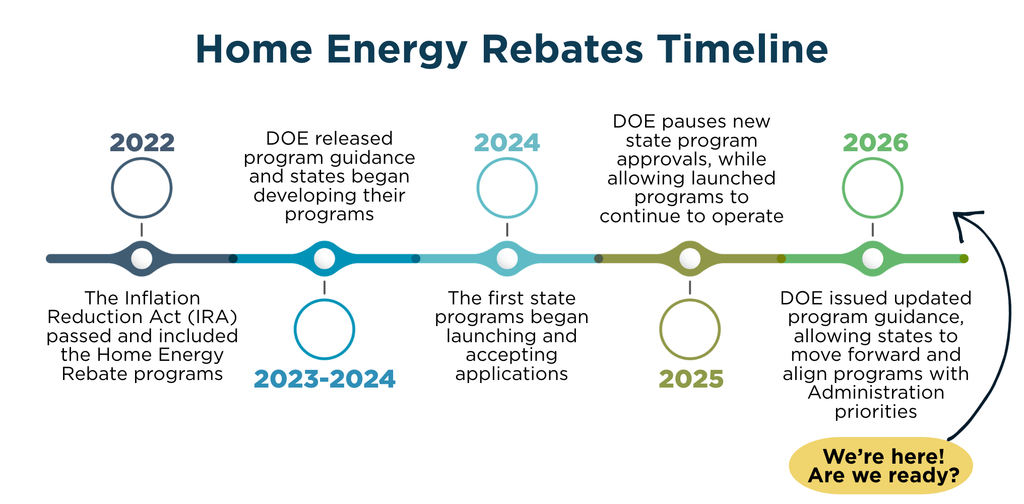
The return of the Home Energy Rebates is welcome news for the building performance industry. After some uncertainty, states are once again launching new HOMES and HEEHR programs using updated guidance released by the Department of Energy earlier this summer. Already, states like West Virginia and Rhode Island have launched new programs under the new guidance, bringing the total number of launched states to 13 (plus DC), with more expected in the coming months. But funding availability is just the start. The question now is whether the industry is ready to turn these funds into completed projects and measurable home improvements.
That means looking beyond the size of the rebates and asking some harder questions. Are there enough contractors to meet the coming demand? Do workers have the skills needed to deliver increasingly complex upgrades? And do states and communities have the infrastructure to connect homeowners with qualified professionals?
The latest data from the U.S. Department of Energy’s 2026 United States Energy & Employment Report (USEER) offers some encouraging signs, along with reasons to pay attention.
Rebates Create Demand
Energy efficiency makes up a significant part of the U.S. energy workforce, employing 2.4 million workers across activities ranging from HVAC and heat pumps to insulation, air sealing, energy auditing, efficient appliances, and advanced building materials.
The return of Home Energy Rebates is likely to increase demand across a wide range of energy efficiency work. That work is inherently interconnected.
A homeowner may start with an energy assessment and end up needing air sealing, insulation, HVAC improvements, a heat pump, electrical work, or a combination of measures. Delivering those projects effectively requires more than a single occupation or technology. It requires coordination across the workforce and a clear understanding of how improvements work together.
DOE’s USEER specifically points to HVAC technicians, energy auditors, and other energy efficiency occupations as areas where demand is expected to grow as states implement Home Energy Rebate programs.
That growth raises a familiar concern: Where will the additional workers come from? If rebate programs generate more leads than contractors can serve, homeowners may face long waits, higher project costs, or difficulty finding qualified professionals. Contractors may have to turn away work or stretch existing teams beyond capacity. And programs could struggle to meet their goals even when funding is available.
Incentives can create a surge of interest quickly, but building the workforce needed to respond takes much longer.
Workforce Readiness
Workforce readiness means having more people, but also ensuring those people have the right skills.
As rebate programs encourage homeowners to take on more comprehensive projects, workers may increasingly need to understand how different systems and measures fit together.
That creates opportunities for cross-training and career development. An HVAC technician may need a stronger understanding of building performance. An energy auditor needs to understand the systems and measures that can address the conditions identified during an assessment. Contractors need to navigate program requirements while managing customer expectations, project economics, and installation quality.
This is particularly important because the building performance workforce does not exist in a neat box. DOE’s USEER points out that many businesses perform energy efficiency work alongside other activities, making the sector difficult to measure through traditional employment classifications.
A roofing contractor may also perform insulation or air sealing. An HVAC company may work on both conventional and high-efficiency systems. Workers may spend part of their time on energy efficiency and part of their time on other construction activities.
That flexibility can be a strength. It also means the industry needs to think creatively about how to recruit, train, and retain workers who can move into energy efficiency work as demand changes. DOE’s recent program updates to the Training for Residential Energy Contractors (TREC) program also provides states with exciting new opportunities to provide down payments on vital home performance contractor training.
But having the right workforce is only part of the equation. The market around those workers also needs to function.
The House is a System—Is Our Industry?
Like an energy efficient home, Home Energy Rebates depend on an ecosystem that connects many pieces. In this case, homeowners, programs, contractors, training providers, manufacturers, and financing all need to work together.
Homeowners need to understand what the programs offer and how to participate. Contractors need a clear path to becoming involved and enough certainty to invest in staff, equipment, and training. Programs will vary by state and will need processes that are straightforward enough to encourage participation while maintaining the standards needed to deliver meaningful energy savings.
And everyone needs confidence that the market will be there long enough to justify the investment.
The Opportunity is Bigger Than The Rebates
The return of Home Energy Rebates should not be viewed simply as a new source of funding for home upgrades. It is an opportunity to strengthen the industry that delivers those upgrades.
That means investing in the people, skills, and infrastructure needed to turn funding into completed projects.
The success of Home Energy Rebates will ultimately be measured not by how much money is allocated, but by what happens after a homeowner applies. Does the project get completed? Is the work done well? Does the homeowner see the expected benefits? Can the contractor make a sustainable business from the work? And does the industry emerge with more skilled workers and stronger market capacity than it had before?
The rebates are moving again. Are we ready?