Skip to content

Research and Reports

BPA publishes research, policy papers, and fact sheets on residential energy efficiency and home performance.

PolicyReport

Retrofitting America’s Homes: Designing Home Energy Programs that Leverage Federal Climate Investments with Other Funding

This report explores the opportunities for states to enhance residential retrofit programs by combining new federal funds with other public and private investments. It offers strategies for effectively integrating multiple funding sources to maximize impact and drive sustainable market transformation. The report also outlines eight key program design elements based on decades of experience and recent advancements to support stakeholders in achieving their retrofit goals.

PolicyReport

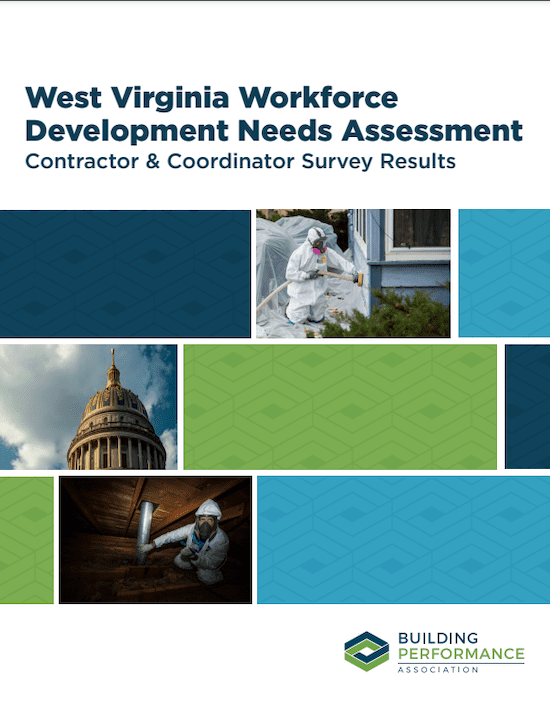
West Virginia Needs Assessment

The report draws upon surveys from BPA’s DOE-funded national needs assessment to determine West Virginia companies’ needs, which will further identify the training and technical support required to grow the local energy efficiency industry.

PolicyReport

National Workforce Development Needs Assessment

This assessment was designed to elicit feedback from BPA members and industry stakeholders on gaps, barriers, and challenges to developing and maintaining a vibrant home performance workforce.

PolicyReport

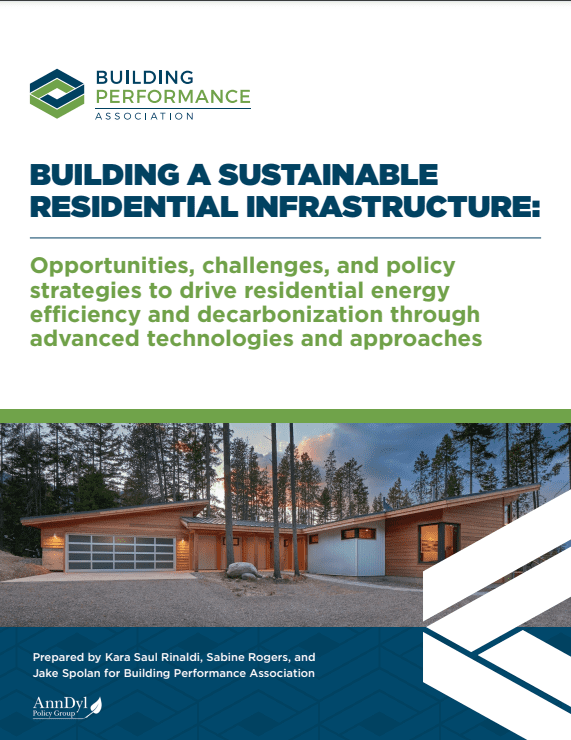
Building a Sustainable Residential Infrastructure

Opportunities, challenges, and policy strategies to drive residential energy efficiency and decarbonization through advanced technologies and approaches.

Cover of the report, "Redefining Home Performance in the 21st Century" by Home Performance Coalition
PolicyReport

Redefining Home Performance in the 21st Century

This report aims to identify and address many of the evolving obstacles to the synergy between home performance and smart home technologies with the ability to make “intelligent” homes more energy-efficient, comfortable, and grid-responsive.

A blue overlay over an arial shot of a neighborhood. White text reading: Making the Value Visible. A blueprint for transforming the high-performing homes market by showcasing clean and efficient energy improvements.
Building Science PrinciplesReport

Making the Value Visible

A blueprint for transforming the high-performing homes market by showcasing clean and efficient energy improvements.

Screenshot of Moving New York Forward on Energy Efficiency in 2018
Comment

Moving New York Forward on Energy Efficiency in 2018

HPC joined Alliance for Clean Energy New York; Association for Energy Affordability; Building Performance Institute (BPI); Building Performance Contractors Association of New York State; Dick Kornbluth, LLC; E4TheFuture; Efficiency First; Performance Systems Development and True Energy Solutions with the goal of harnesses the market for energy efficiency, in order to create jobs while implementing Governor Cuomo’s Reforming the Energy Vision (REV) and his commitment to energy efficiency in the 2018 State of the State Address.

Screenshot of Letter & Background Research on Energy Efficiency and Policy Related to H44
CommentPolicy

Letter & Background Research on Energy Efficiency and Policy Related to H4425

HPC urged Chairman Delleney and the South Carolina House Judiciary Committee to support the energy efficiency provisions of H4425. HPC believes the energy efficiency provisions of H4425 are the lowest cost, most predictable and most immediate method to reduce energy demand, create local jobs and provide opportunities for small business energy efficiency entrepreneurs in South Carolina. This letter provides background research and information on H4425.

Screenshot of HPC Files Comments on New Efficiency New York
CommentPolicy

HPC Files Comments on New Efficiency New York

HPC participated in a broader working group of residential building industry organizations to prepare comments (also attached) on the New Efficiency, New York White Paper. That working group included: Association for Energy Affordability, Inc., Building Performance Institute (BPI), Building Performance Contractors Association of New York State, Dick Kornbluth, LLC, E4TheFuture, Efficiency First, HPC, Performance Systems Development, Seek More LLC and True Energy Solutions. Several of those organizations also submitted individual comments.

A screenshot of a document of HPC Comments
CommentPolicy

HPC Comments to Support New Jersey’s 2019 Energy Master Plan Development

As leaders in the residential energy efficiency industry, the Building Performance Associations respectfully responds to the September 14, 2018 request by the New Jersey Board of Public Utilities (NJ BPU) to provide feedback on Discussion Points, addressed here by number as presented, in order to support New Jersey’s development of its 2019 Energy Master Plan and the strategic vision for the state’s role in “development, use, distribution, and management of energy.” Where a specific question is addressed, we note the number and question. This response links to several studies and resources to assist the BPU staff. In addition, we appreciate being able to offer comments not specifically requested and we place those under the relevant discussion point topics.

A screenshot of the document, Comments to Senate Tax Task Force.
CommentPolicy

Comments to Senate Tax Task Force

As a national non-profit organization seeking to advance residential building performance across the country, the Building Performance Association respectfully urges your support for tax incentives for homeowners that invest in sound residential energy efficiency home upgrades, tax incentives like a forward-looked, expanded 25C tax credit.

Screenshot of the Energy and Commerce Committee Request for Input – Decarbonization, Net Zero by 2050
CommentPolicy

Energy and Commerce Committee Request for Input – Decarbonization, Net Zero by 2050

As leaders in the residential energy efficiency industry, E4TheFuture and the Building Performance Association appreciate the opportunity to provide responses to the questions put forth by the House Energy and Commerce Committee on August 27, 2019. We support the Committee’s goal to achieve a 100 percent clean energy economy by 2050 and look forward to working with the committee to advance legislation to meet that goal.